Field guide 03 · Cold water
Kayaking with Clear Limits
Still-looking water is not a complete risk assessment. Your route must remain manageable after a capsize, a wind change or a delayed return.
Begin with immersion, not air temperature
Fjord water can remain cold when the air feels comfortable. Sudden immersion may disrupt breathing and rapidly reduce useful movement. A buoyancy aid is essential equipment, but it does not provide adequate thermal protection by itself. Choose clothing for likely water exposure and rescue time, not simply for how warm you expect to feel while paddling.
A correctly selected and fitted drysuit or wetsuit may be appropriate depending on conditions and the activity. Neither replaces training, a suitable boat or a practiced rescue plan. Have an instructor or qualified operator help assess fit and suitability. Carry dry insulation in waterproof storage and understand how you would reach a usable landing after an incident.
Wear an appropriate, well-fitted personal flotation device throughout the outing. Know how any spray deck releases and practise the relevant wet exit under qualified supervision. Equipment that you have never used in water is not a reliable solution to an unexpected capsize.
Read the return journey
Wind can accelerate along a fjord or descend abruptly from surrounding terrain. A sheltered inlet may conceal stronger conditions beyond a headland. Check the marine forecast, local observations and the expected change during the whole outing, then compare these with conditions your group has actually handled.
Do not use a single universal wind limit from an article as permission to launch. Direction, gusts, waves, water temperature, shoreline shape and rescue ability all matter. If the assessment requires explanations you cannot confidently make, choose instruction or a qualified local guide.
Nærøyfjord, Aurlandsfjord, Geirangerfjord and Lysefjord have different combinations of traffic, steep shorelines and access. Their scenic reputations do not imply interchangeable paddling conditions. Ask locally about boat movements, wakes, landing restrictions and places where getting ashore may be difficult.
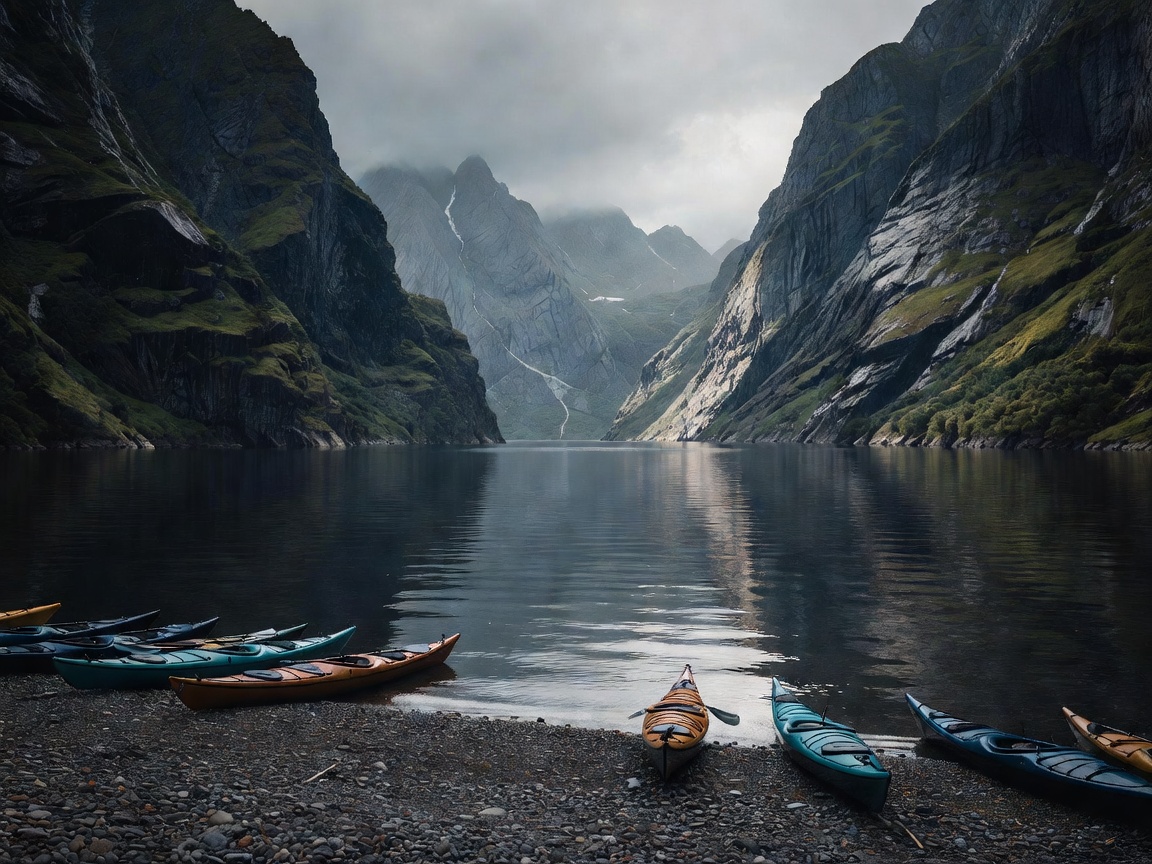
Use a launch decision checklist
People and equipment
- Everyone is comfortable with the proposed conditions
- Clothing and flotation are suitable and fitted
- Boat, hatches and safety equipment are checked
- Communication is accessible if separated from the kayak
Route and recovery
- Forecast and observations agree sufficiently
- Return conditions remain within practiced ability
- Usable landings and a shorter alternative are known
- A trusted person has the plan and overdue procedure
Rescue skills should be practised in controlled conditions with competent supervision, then developed for the environment you intend to use. A successful pool exercise does not automatically transfer to cold water, waves or fatigue. Going with another inexperienced paddler is not equivalent to having a capable rescue partner.
Keep the route conservative
Avoid committing crossings and long stretches without usable exits unless your training, group and conditions genuinely support them. Staying close to shore is not sufficient if that shore is a vertical cliff, breaking waves or a place where landing would damage habitat. Identify real recovery options on a chart and confirm them locally.
Keep a lookout for commercial vessels and follow local navigation rules. Make your group visible and predictable, and never assume a large vessel can see or avoid a low kayak. Do not linger in navigation channels or approach wildlife to obtain a photograph. Give birds and marine animals space and move away if your presence changes their behaviour.
For a first fjord outing, a guided session in a suitable sheltered area can be a better choice than independent rental. Ask about instructor qualifications, group size, cold-water equipment, rescue arrangements and cancellation decisions. Norwegian Canoe Association training, including its Våttkort pathway, can help structure further learning; rental requirements vary by operator.
If a launch decision feels marginal, choose a shore walk or training session instead. Reserving a boat or travelling a long way does not improve the conditions. Cancel while the choice remains simple.